Jeju Black Pork · Xiaohongshu Ad / Why Xiaohongshu is essential for a Jeju black pork restaurant
A Jeju black pork restaurant that is not on Xiaohongshu never makes a Chinese traveler's dinner shortlist
From January to August 2026, 1.86 million Chinese travelers visited Jeju. The first dinner they think of after landing is black pork, and the place they decide which black pork restaurant to visit is not Naver but Xiaohongshu. On Xiaohongshu, with 400 million monthly users and 800 million searches a day, a search for Jeju black pork returns other travelers' notes, and the traveler compares three or four of them to pick a restaurant. If your restaurant is not in that comparison, it does not exist for that traveler. This guide covers four reasons Xiaohongshu is essential for a Jeju black pork restaurant, the four steps Chinese travelers take to pick one, six things a note must contain, the three stages of advertising, what the owner prepares and what we do, and five failures we see most often. How travelers themselves judge a black pork restaurant is in our Jeju black pork guide, and the overall order for China marketing is in Where a Jeju business starts with China ads.
2026 Chinese visitor flow and the scale of Xiaohongshu · 4 reasons it is essential for black pork restaurants · the 4 steps travelers take to pick one · 6 things a note must contain · 3 stages of advertising · what you prepare and what we do · 5 failures. A Jeju advertising agency run by an advertising photographer who has shot more than 200 Jeju businesses.
1.86M
Chinese visitors to Jeju, Jan-Aug 2026
400M
Xiaohongshu monthly users
800M
Xiaohongshu searches per day
200+
Jeju businesses we have photographed
Note · Vol.01
For Chinese travelers, dinner in Jeju means black pork, and they pick the restaurant on Xiaohongshu
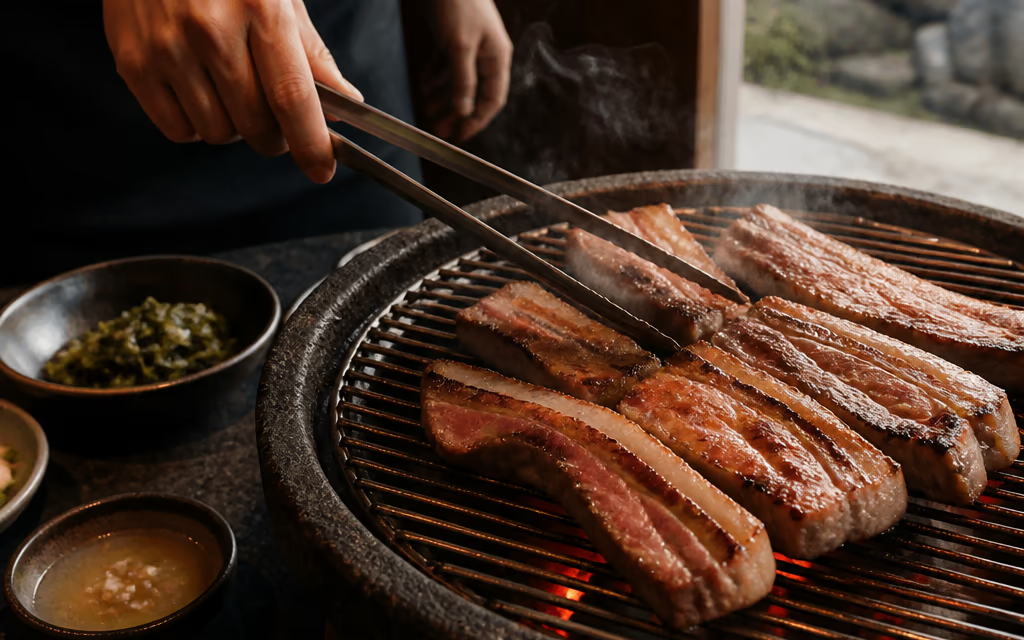
Let us start with two numbers: how many guests there are, and how large the app they use is. According to a September 2026 report citing Jeju Special Self-Governing Province and the Jeju Tourism Organization, 1.86 million Chinese travelers visited Jeju from January to August this year, passing last year's full-year total of 1,588,107 in eight months. Visa-free entry for Chinese group tourists, in force since September 2025, has been extended to December 31, 2026, and Jeju has always been visa-free for individual travelers, so this year both groups and individuals can come easily.
The other number is Xiaohongshu. In May 2026 the head of Xiaohongshu's community operations disclosed for the first time that monthly users had passed 400 million and daily searches 800 million. A report a month later put daily users at 170 million. For a black pork restaurant owner these numbers mean one thing. Xiaohongshu is not a photo-sharing app. It is the search engine where Chinese travelers type Jeju black pork. What Korean guests do on Naver when they search for a Jeju black pork restaurant, Chinese guests do on Xiaohongshu.
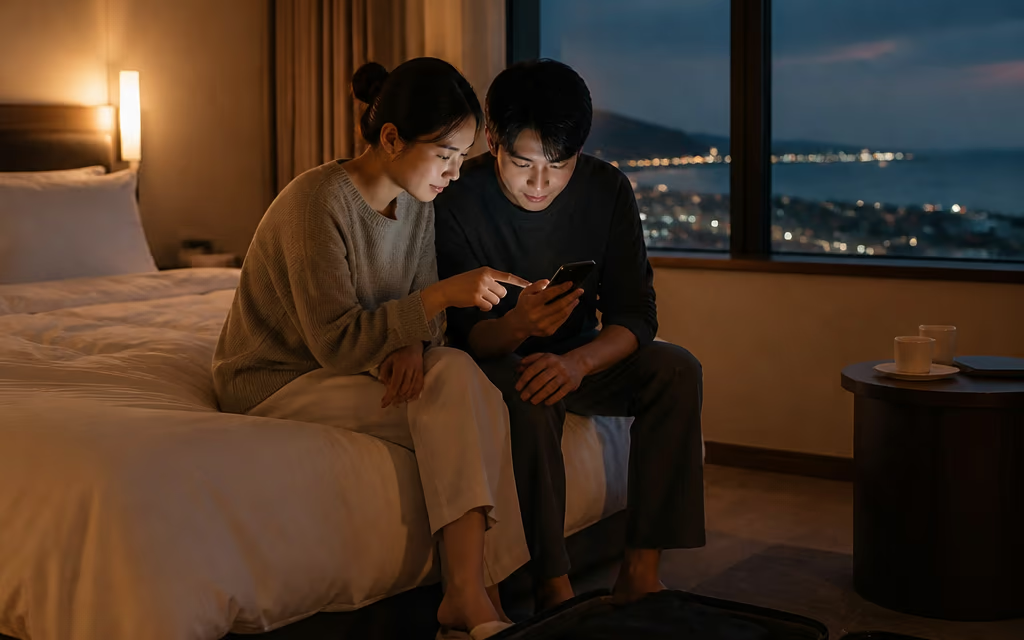
Working with restaurant owners in Yeon-dong, Nohyeong-dong and Jungmun, we have looked at countless Chinese travelers' phone screens. On the first evening in Jeju, after dropping their bags at the hotel, they sit on the bed, open Xiaohongshu and search for Jeju black pork, Jeju black pork restaurant, black pork barbecue. For a Chinese traveler, dinner in Jeju is all but decided as black pork, and the only question is which restaurant. That question is settled while flipping through three or four Xiaohongshu notes.
That is why this guide looks at Xiaohongshu through a single business type, the black pork restaurant. Unlike a cafe or a hotel, a black pork restaurant receives guests who have already chosen the dish, so Xiaohongshu's role is sharper. It is not the place of discovery but the place of comparison, and a restaurant missing from the comparison does not exist for the guest. The overall structure of Xiaohongshu marketing is in our Jeju Xiaohongshu marketing guide. This article rewrites that structure around one dinner at a black pork restaurant.
Note · Vol.02
Four reasons Xiaohongshu is essential for a black pork restaurant
A word like essential needs reasons behind it. When we recommend Xiaohongshu to a black pork restaurant owner we give four, and all four are conditions already fixed on the guest's side, regardless of the restaurant's food or service.
| No. | Reason | What happens at a black pork restaurant |
|---|---|---|
| 01 | Black pork is the Chinese traveler's first dinner choice | They are not deciding whether to eat it but which restaurant, and that comparison ends inside Xiaohongshu |
| 02 | Xiaohongshu is used as a search engine | With 800 million searches a day, typing Jeju black pork returns other travelers' notes as results |
| 03 | Competing black pork restaurants are already there | A restaurant that never enters the comparison is not a candidate, however good the food |
| 04 | One note leads all the way to directions | A guest who moves from a note to Dianping confirmation and Amap directions sits in your restaurant that evening |
First, the dish is decided in advance. Chinese travelers arrive in Jeju having already decided to eat black pork. So a black pork restaurant's Xiaohongshu presence is not where you persuade guests to try black pork; it is where you are weighed against other black pork restaurants. The comparison happens inside notes, and a restaurant with no notes is never compared at all. Second, Xiaohongshu is used as a search engine. Where 800 million searches happen a day, a search for Jeju black pork returns not the restaurant's advertising but other travelers' notes, and guests trust those notes when they choose.
Third, competitors are already there. A good number of black pork restaurants in Yeon-dong and Nohyeong-dong already have notes stacked up on Xiaohongshu. How restaurants around Dream Tower get onto Chinese guests' dinner shortlist is covered in our Xiaohongshu restaurants around Dream Tower guide. If the restaurant next door appears on the guest's screen and yours does not, the guest sits next door even if your food is better. A restaurant that never enters the comparison is not a candidate from the start.
Fourth, one note leads all the way to directions. A guest who has chosen a restaurant on Xiaohongshu confirms it exists on Dianping and finds the way on Amap. When these three channels are connected, the guest who read the note sits in your restaurant that evening; when they are not, the guest reads the note and never arrives. How the two platforms are set up as a pair is in Registering on Xiaohongshu and Dianping, and the map side is in Registering a Jeju business on Amap. None of these four reasons is something a restaurant can change. The only thing it can change is whether it is present inside them.
Note · Vol.03
The four steps a Chinese traveler takes to pick a black pork restaurant, and six things a note must contain
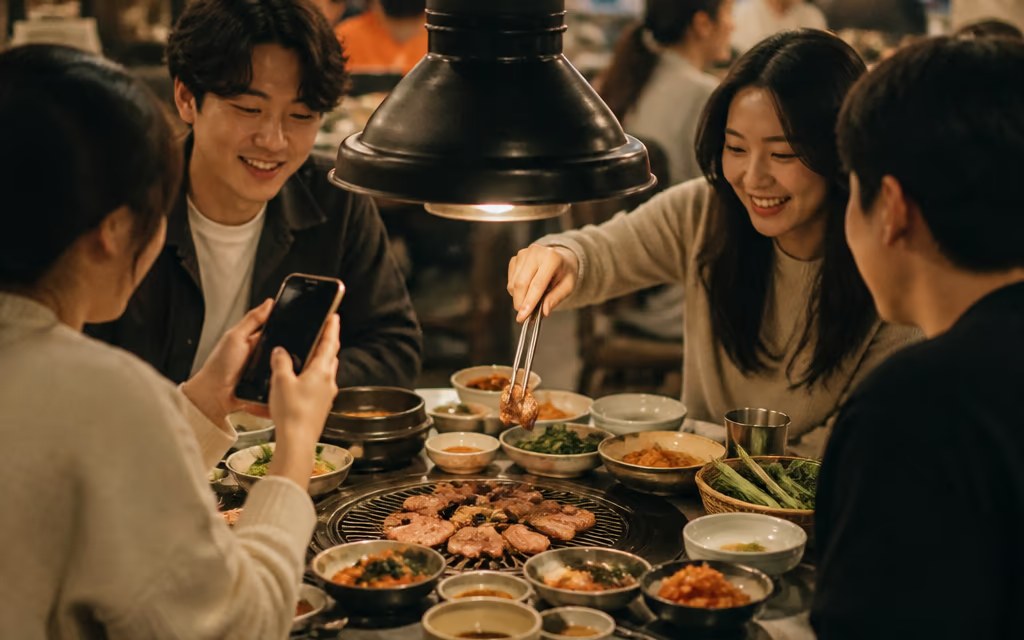
Split the way a guest picks a black pork restaurant into four steps and it becomes clear where a restaurant has to set what up. The table below is the sequence we have seen again and again on travelers' screens while working with restaurant owners.
| No. | Step | Where | What the guest does |
|---|---|---|---|
| 01 | Search | Hotel · Xiaohongshu | Searches Jeju black pork or Jeju black pork restaurant and flips through other travelers' notes |
| 02 | Compare | Xiaohongshu notes | Weighs three or four restaurants on meat photos, price per person, distance from the hotel, how to eat it, and whether there is a queue |
| 03 | Confirm | Dianping | Checks the chosen restaurant really exists, its reviews, hours and whether it takes reservations |
| 04 | Directions and visit | Amap · the restaurant | Checks it is walkable from the hotel, comes in, and experiences the menu and payment |
Step one is the search: opening Xiaohongshu at the hotel and typing Jeju black pork. Step two, the heart of this guide, is comparison. The guest opens three or four notes side by side and compares the cross-section photos of the meat, the price per person, the distance from the hotel, how a first-timer should eat it, and whether there is a queue. The note that wins this comparison is not the prettiest one but the one that answers what the guest is asking. Step three is confirmation on Dianping, and step four is arriving via Amap and experiencing the menu and payment on site.
That fixes what a note must contain. The six items below are what we always include when we build a black pork restaurant's notes. They are the questions guests actually ask most often in note comments, and if any one is missing the guest moves on to another restaurant's note that has the answer.
| No. | What must be in the note | Why it matters |
|---|---|---|
| 01 | Photos of the meat on the grill and in cross-section | The first criterion for choosing a black pork restaurant; thickness, fat and color are read from one photo |
| 02 | Price per person and what a party of a given size will pay | The question Chinese guests ask most often in note comments |
| 03 | Meljeot anchovy sauce and how to eat each cut | For a first-time black pork eater this becomes the reason to choose your restaurant |
| 04 | Distance from the hotel districts and opening hours | An evening search is a search for a restaurant you can walk to right now |
| 05 | Whether there is a queue, whether it takes reservations, whether groups are welcome | The most common place where expectations and reality diverge |
| 06 | Whether there is a Chinese menu and which payment methods work | Removes the last worry at the confirmation step |
Of the six, the ones restaurants most often leave out are price and distance. A note with atmosphere shots and meat shots but no word on what a party pays or how many minutes it is from which hotel district loses at the comparison step. Conversely, a note with ordinary photos but clear price, distance and eating instructions keeps collecting saves. Which words and which photos fill these six items differs by restaurant, and deciding that is the first thing we do in a consultation. How cross-section and grill photos of black pork change is in our Jeju food photography guide.
Xiaohongshu visibility check
Give us the restaurant's name
and we will first check how it appears on Chinese guests' screens today
Note · Vol.04
Three stages of Xiaohongshu advertising for a black pork restaurant: build, fill, switch on
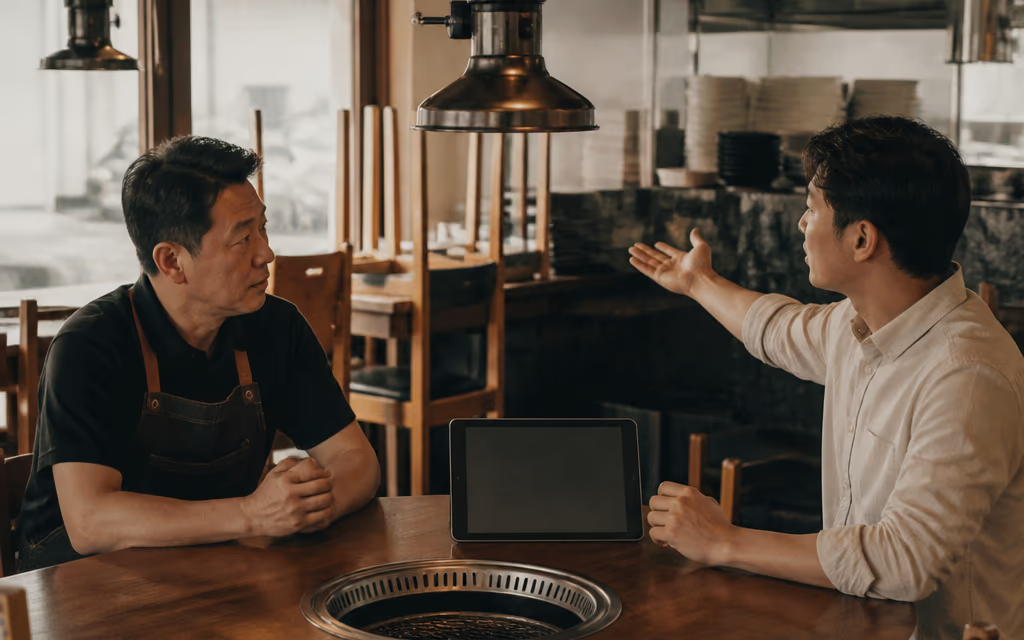
When people hear Xiaohongshu advertising they think of paid exposure first, but for a black pork restaurant paid exposure is the third stage. The order we follow with black pork restaurants is build, fill, switch on. Keep that order and the money spent in stage three lands on the foundation the first two stages built.
| No. | Stage | What is done | Where the budget goes |
|---|---|---|---|
| 01 | Build | Register the restaurant account · photograph the meat, the table and the restaurant · produce seed notes · connect Dianping and Amap | Registration, photography and notes; no paid exposure |
| 02 | Fill | Influencer visit · note posted the same day · reviews accumulate · check the Chinese menu and payment | Influencer visit; a small test of paid exposure |
| 03 | Switch on | Run paid exposure · track impressions, saves and direction requests · log Chinese guest tables · adjust next month | Weight shifts to paid exposure |
Stage one is building. We register the restaurant account in the restaurant's own name, photograph the meat, the table setting and the restaurant, produce seed notes containing the six items from the previous chapter, and connect the restaurant on Dianping and Amap. No paid exposure is switched on at this stage. Because photos are the basis of comparison for a black pork restaurant, this is the stage where photography gets the most care, and since our CEO is an advertising photographer, one team finishes registration and the shoot in the same week.
Stage two is filling. A mainland Chinese influencer visits the restaurant and posts a note the same day, and as that note stacks up beside the seed notes the restaurant starts to appear at the comparison step. If an influencer is brought in first while the restaurant has no reviews at all, the guest who goes to confirm after reading the post sees an empty page and turns away, so this stage always comes after stage one. How an influencer visit turns into a same-day note is in Xiaohongshu influencer on-site posting. The Chinese menu and payment methods are checked at this stage as well.
Stage three is switching on. We run paid exposure, watch impressions, saves and direction requests, and the restaurant logs the number of Chinese guest tables by date. The structure of paid campaigns is in Xiaohongshu and Dianping ads. The budget moves from registration, photography and notes in stage one, to the influencer in stage two, to paid exposure in stage three, and because the amount depends on seat count and the type of guest you want, we give each restaurant its own proposal in consultation. We do not put a single figure in this guide because that figure would be too much for one restaurant and too little for another.
Note · Vol.05
What the owner prepares · what we do
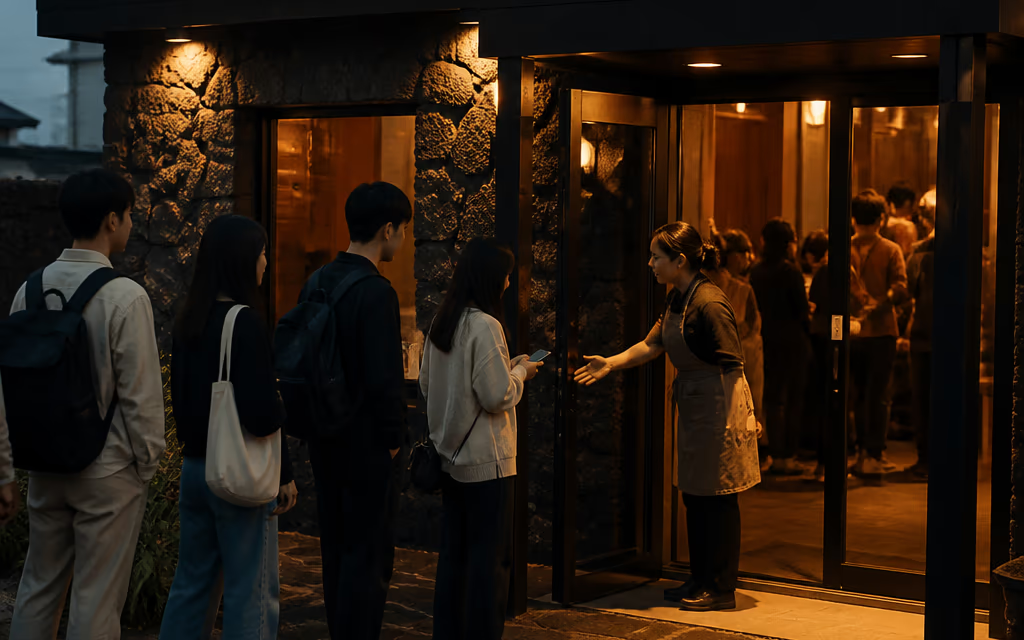
For the three stages to hold, who does what has to be settled from the start. The owner's job is to give us the information only the restaurant knows and to make the preparations only the restaurant can make inside its own walls. Our job is to turn that information into what Chinese guests read, and to build and run the channels.
| No. | What the owner prepares | What we do |
|---|---|---|
| 01 | Business registration · location and hours · a contact number | Register and verify the Xiaohongshu account, connect Dianping and Amap, keep the account in the restaurant's name |
| 02 | Signature dishes and prices by cut · what you cannot do (no reservations, no groups, when cuts sell out) | Rewrite the menu and description the way Chinese guests ask · photograph the meat, the table and the restaurant |
| 03 | Decide which guests to take (individuals · groups · both) | Design the note content and the three-stage order to match the guest type |
| 04 | Put out a Chinese menu · apply for payment methods | Check what goes on the menu and where it sits · advise at which stage each is needed |
| 05 | Log Chinese guest tables by date | Report monthly alongside impressions, saves and direction requests; adjust next month's budget |
The first thing the owner provides is the business registration, the restaurant's location, hours and a contact number. With this we register the Xiaohongshu account and connect Dianping and Amap. The account stays in the restaurant's name. If an agency opens the account in its own name, the restaurant cannot take its notes and reviews with it when the agency changes, which is the fifth failure in the next chapter. The second is signature dishes, prices by cut, and what you cannot do. Telling us in advance that you do not take reservations, cannot seat groups, or run out of a certain cut at a certain hour puts that into the note and reduces the gap between what the guest expects and what they find.
The third is deciding which guests to take. Whether you take individuals only or groups as well changes the note content and the order of the three stages, so this decision is the owner's. The fourth is putting out a Chinese menu and applying for payment methods. Payment methods are something the restaurant applies for directly through a domestic payment provider; we look at what the menu needs to include and at which stage it should be ready. The fifth is logging the number of Chinese guest tables by date. Without that number there is no basis, from stage three on, for matching channel figures against reality and adjusting next month's budget.
Everything in between is what we do. We handle registration and verification, photograph the meat, the table and the restaurant, build notes containing the six things Chinese guests ask about, run influencer visits and paid exposure at the point that suits the restaurant's state, and report impressions, saves and direction requests monthly alongside the owner's table counts. How much you do yourself and where you hand over is decided in consultation, and for the parts you keep we give you a checklist. If you would like to see for yourself how your restaurant currently appears in Chinese guests' searches, you can follow the steps in Xiaohongshu self-check for your business first.
Note · Vol.06
Five failures black pork restaurants make most often on Xiaohongshu
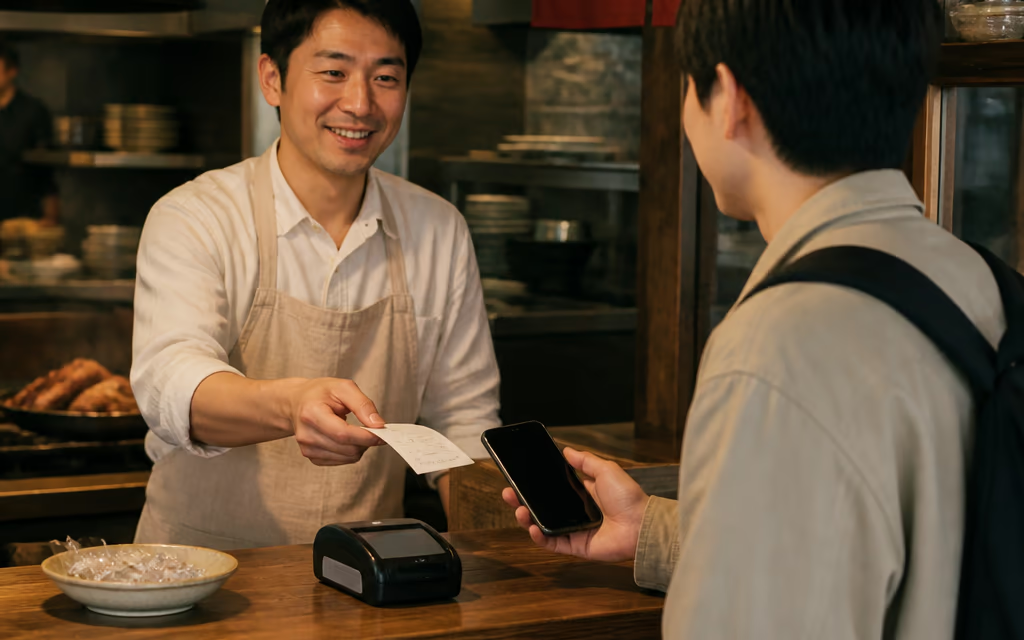
Finally, the failures we met repeatedly in black pork restaurant consultations this year. None of the five happened because the meat was bad. They happened because the order in the previous chapters, or the six items in the note, was skipped.
| No. | Failure | Result |
|---|---|---|
| 01 | Bringing in an influencer before the restaurant account exists | The post goes up but guests have nowhere to confirm it, so they go next door |
| 02 | Running Korean-market photos and text through a translator | The words differ from what Chinese guests search for, so nothing shows up |
| 03 | Posting atmosphere shots with no price or distance | Loses to other restaurants at the comparison step |
| 04 | Bringing guests in with no Chinese menu or payment method | Guests blocked on site leave a poor review |
| 05 | Stacking everything in an account in the agency's name | When the agency changes, the notes and reviews are no longer the restaurant's |
The first is bringing in an influencer before the restaurant account exists. This year we saw several restaurants that accepted an agency pitch and brought in an influencer right away with no restaurant account and no Dianping listing. The guest who reads the post has nowhere to confirm it, goes to the black pork restaurant next door, and that money becomes the neighbor's revenue. The second is running Korean-market photos and text through a translator. The sentences are in Chinese but not in the words Chinese guests search for, so the note is not found, and when it is found it is not read at the comparison step.
The third is posting atmosphere shots with no price or distance. The photos are good, but a note that does not say what a party pays or how far it is from the hotel does not get saved. The fourth is bringing guests in before there is a Chinese menu and a payment method. When a guest who came from Xiaohongshu cannot understand the menu or gets stuck at payment, that confusion ends up in a review, and that review blocks the next guest's confirmation step.
The fifth is the most painful. Notes and reviews are stacked up in an account in the agency's name, and when the agency changes or the contract ends, everything accumulated stops being the restaurant's. Keeping the account in the restaurant's name with the login details held by the restaurant is the only way to prevent this, and it is why we do it that way at the registration stage. Marketing for Jeju barbecue restaurants more broadly, black pork restaurants included, is covered in Jeju barbecue restaurant marketing. A black pork restaurant that wants Chinese guests should first check the four steps, the six items and the three stages in this guide. How your restaurant currently appears on Chinese guests' screens is something we can check from the restaurant's name alone.
FAQ
Frequently asked questions
We run a black pork restaurant. Do we really need Xiaohongshu? Isn't Naver Place enough?+−
How many posts on Xiaohongshu does it take before guests come?+−
Isn't the competition among black pork restaurants on Xiaohongshu too fierce?+−
Can the owner run Xiaohongshu directly?+−
If we bring in an influencer, will guests increase right away?+−
How much does Xiaohongshu advertising cost?+−
Can we use phone photos of the black pork?+−
Do we also need a Chinese menu and Chinese payment methods?+−
Does it work for a black pork restaurant in Seogwipo rather than Yeon-dong or Nohyeong-dong in Jeju City?+−
Can we get group guests through Xiaohongshu?+−
What exactly does Kimjakga Inc. do in all this?+−
Korean original · other languages
제주 흑돼지 광고, 샤오홍슈가 필수인 이유 · 중국 손님이 흑돼지 집을 고르는 네 단계와 노트에 들어가야 하는 것, 사장님이 준비하실 것과 저희가 하는 것
CTA
A black pork restaurant that makes the Chinese guest's dinner shortlist,
from registration to paid exposure, built by Kimjakga Inc.
Jeju advertising agency · Chinese guest marketing
Kimjakga Inc. · Kim Young-gyu · 95 Gwawonbuk 4-gil, 3F, Jeju-si, Jeju Special Self-Governing Province, Korea
Sources · Jeju Special Self-Governing Province · Jeju Tourism Organization figures (about 1.86 million Chinese visitors to Jeju, Jan-Aug 2026), Seoul Shinmun, Sept. 22, 2026 · Consulate General of the Republic of Korea in Qingdao, notice on the extension of visa-free entry for Chinese group tourists (July 1 to Dec. 31, 2026) · Huxiu, May 29, 2026 (Xiaohongshu 400 million monthly users · 800 million searches a day) · The Paper, June 16, 2026 (170 million daily users)
This site uses AI-generated images to aid visual understanding.